
Products
BuTech Valves, Fittings and Tubing
haskel-logo.png

Reach Out To Us

Have questions or need more information?

What Is a Pneumatic‑Driven Liquid Pump?

A pneumatic‑driven liquid pump is a positive displacement pump that uses compressed air to generate safe, reliable, and economical hydraulic pressure. It operates by converting air pressure into hydraulic power, enabling long‑duration hydrostatic pressure testing and maintaining a set pressure without additional energy consumption.


Operating principles of pneumatic driven liquid pumps

The pneumatic pumps automatically reciprocate on a differential piston principle. In a hydraulic system, smaller pistons are directly driven by larger pistons whereas the larger pistons are driven by relatively low pressure compressed air.

The model coding of Haskel’s air-driven liquid pumps indicates the nominal ratio between the air piston and the hydraulic piston. The maximum hydraulic output pressure is calculated by multiplying the ratio of the pump by the shop air pressure being used to drive the pump.

When the pump is first turned on, it acts as a transfer pump, filling the volume with liquid. During this time, the pump cycles at its maximum speed. Once the liquid has been transferred, pressure inside of the pump will increase until it reaches a certain point and then begins to slow down naturally. The stalled condition can last indefinitely unless something disrupts equilibrium (for example: turning off the power).

The pump will automatically start to cycle once the pressure is released or if the drive air pressure is increased. This feature makes this type of pump an excellent choice for pressure testing.
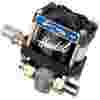
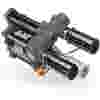
15 hp Pneumatic Pump - Haskel

Anatomy of a Pneumatic Driven Hydrostatic Test Pump

1. Drive Section
Pistons with O-ring seals operate in, fiberglass wrapped cylinders. The cylinder diameter is constant for a particular pump series. The driving medium pushes the piston down on the compression stroke and lifts it on the suction stroke (the M series has a spring return). No drive air lubricant is required as the piston is pre-lubricated during assembly.

2. Hydraulic Section/Check Valves
In the hydraulic section, the drive piston connects to the hydraulic plunger/piston. Hydraulic pistons have different sizes depending on their nominal ratio. The higher ratio pumps can achieve higher pressures, but have smaller displacements, which translates to less flow per stroke.

During the down stroke, the inlet check valve keeps the liquid in the pump from flowing back into the suction line while it is compressed by the plunger. On the return or suction stroke, fresh liquid is drawn in through the inlet check valve, while the outlet check valve closes.

These check valves control the flow of liquid through the hydraulic section. They are spring-loaded and have a very low cracking pressure, which allows maximum flow during suction. Inlet check valves are closed by the hydraulic fluid pressure on downstrokes. At the same time, the outlet check valves open when the hydraulic pressure in the pump exceeds the pressure in the system after the pump.

3. Drive Cycling Valve
This is a pilot operated, unbalanced lightweight spool that cycles the driving pressure first to the top of the driving piston and then to the bottom to cycle the piston. It is actuated through control valves at the beginning and end of stroke, causing the spool to move out of balance and the piston to move up and down.

4. Hydraulic Seal/Check Valves
A hydraulic seal is one of the few parts that wear out. Basically, it prevents fluid from flowing into the actuator while the hydraulic piston is moving back and forth. Seal specifications are determined by the fluid, its pressure and temperature. Most Haskel pumps can be operated without contamination by use of a vent or distance piece between the pump section and the air drive.

6 hp Pneumatic Pump - Haskel
Banner Haskel

Discover Our Portfolio of Liquid Pumps

The following models and configurations are available to meet a wide range of application requirements.

Banner For Liquid Pumps

Advanced Pump Configuration

Enter your requirements and let our advanced tool recommend the best liquid pump for your application

Haskel Pneumatic Driven Liquid Pumps are not only extremely reliable, robust, compact, and easy to maintain, but also offer the following advantages:


  • No heat, flame or spark risk during pneumatic operation
  • Able to reach up to 100,000 psi (7000 bar)
  • ATEX certified
  • Infinitely variable cycle rate
  • Block function at predetermined pressure to maintain this pressure without consuming energy
  • Trouble-free start/stop applications
  • Easy automation with a wide range of control and adjustment options available
  • Suitable for most liquids and liquefied gasses
  • No need for air-line lubrication, reducing costs and preventing contamination

Applications

Discover the Right Liquid Pump – Fast and Simple

Quickly compare Haskel liquid pump performance across horsepower ranges with clear flow‑and‑pressure charts. Assess operating ranges at a glance using simplified performance curves and air‑drive indicators. Trusted worldwide, Haskel delivers industry‑leading reliability backed by decades of high‑pressure engineering.
.33 HP Air Driven Pump Models

Frequently Asked Questions

Haskel pumps offer several differentiators — safe pneumatic operation with no heat, flame or spark risk, pressures up to 100,000 psi (7000 bar), the ability to stall at a pre‑set pressure without consuming power and infinitely variable cycling speed. They are compact, reliable and require no air‑line lubrication, reducing cost and contamination risk.